The Wolf Cut is the most searched haircut in the UK for the second year running – and unlike most trends, it hasn’t faded. It’s evolved. What started as a viral moment has become a genuine fixture in London salons, requested by clients across every age group and hair type. The reason isn’t nostalgia or social media momentum. It’s that the cut actually works.
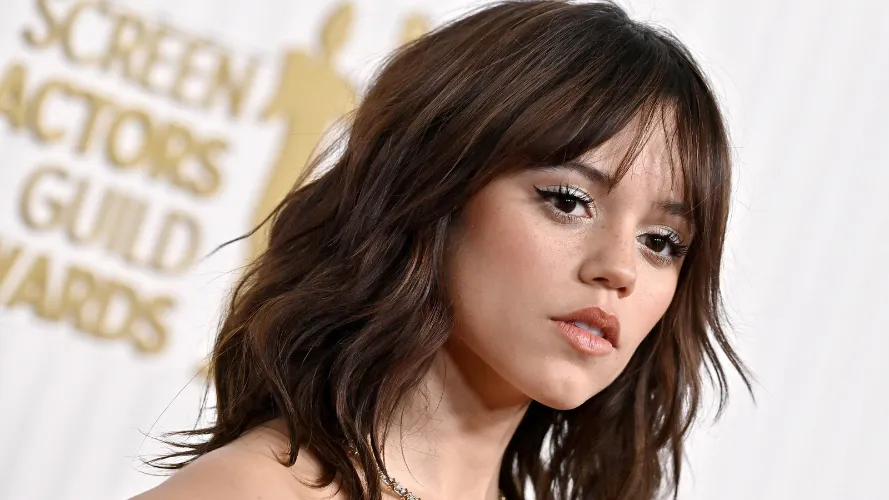
What Is a Wolf Cut?
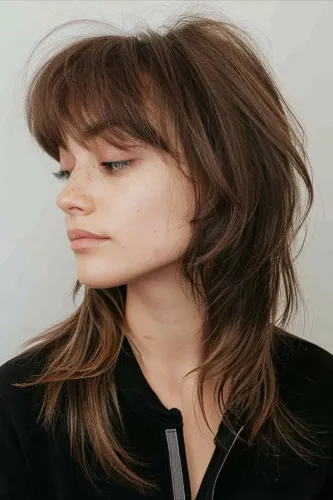
The Wolf Cut is a layered haircut built on the structural principles of two classic shapes: the 70s Shag and the 80s Mullet. Volume is concentrated at the crown through short, choppy layers. Length is preserved at the nape. The transition between the two is where the stylist’s skill shows – it’s the balance of that crown-to-nape ratio that determines whether the cut looks intentional or just overgrown.
The defining features are:
- Heavy layering from the crown downward, creating lift and movement
- A curtain fringe (or soft, face-framing pieces) that blend into the side layers
- Weight removed from the mid-lengths to allow the hair’s natural texture to surface
- A longer perimeter at the nape that gives the cut its signature silhouette
How does it differ from other popular cuts?
The Wolf Cut is often compared to the Butterfly Cut and the standard layered haircut – and the distinctions matter.
The Butterfly Cut focuses its volume specifically at the crown, with layers that fall in two distinct “wings” at the sides. It’s softer and more uniform. The Wolf Cuts are more disconnected – the layers vary more dramatically, and the contrast between the short crown layers and the longer nape is more visible.
A standard layered cut adds length variation for movement, but the placement is generally even and blended throughout. The Wolf Cuts use layering structurally – the goal is not just movement, but deliberate architectural contrast.
Who is the Wolf Cut for?
Nearly everyone. It adapts to straight, wavy, and curly textures. It works on hair from collar-length upward. The technique changes significantly depending on your texture, density, and growth patterns – but the framework is universal. The sections below explain exactly how it translates across different hair types.
For Straight and Fine Hair
Fine, straight hair has one persistent problem: gravity. Without wave or curl to provide lift, hair sits flat against the scalp, and any length pulls volume further downward. A blunt cut makes this worse. A carelessly layered job makes it look thin.
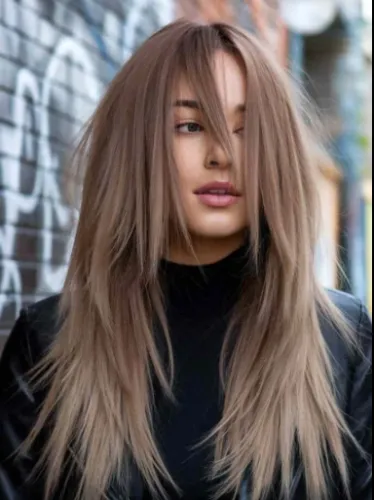
The challenge with fine hair
Most people with fine, straight hair have been told their options are limited – keep it short, or accept the flatness. Neither is true. The issue isn’t the texture itself; it’s how the weight is distributed. When all the density sits at the ends, the root area has nothing to push against.
How the Wolf Cut addresses it
Our stylists working with fine textures rely on internal layering – removing weight from within the mid-shaft rather than cutting into the visible perimeter. The result:
- Ends remain full and connected, so the haircut reads as dense
- The scalp area gains structural lift without looking disconnected
- Point-cutting at the crown creates movement that catches light rather than collapsing
Combined with a curtain fringe shaped to graze the cheekbones, the finished shape has an architectural quality – volume exactly where it’s needed, clean lines everywhere else.
Styling for fine hair
A lightweight texturising mist applied to damp hair before diffusing is enough. The goal is a finish that looks deliberate, with just enough separation in the layers to catch the light. Avoid heavy creams or oils – they re-introduce the weight that the cut worked to remove.
The bottom line: a Wolf Cut on fine, straight hair creates the illusion of density that no volumising shampoo can replicate. It works because the structure does the heavy lifting.
For fine hair especially, the result depends entirely on what happens before the cut starts. Book a women’s haircut with one of our senior stylists – density and growth direction are assessed first, so every layer placement is deliberate.
For Wavy and Movement-Rich Hair
Wavy hair is full of potential that bulk consistently undermines. The natural S-bend is there – but when the hair hangs heavy, the wave flattens, frizz takes over, and the shape loses definition. Most people with wavy hair have spent years negotiating with this. The Wolf Cut stops the negotiation.
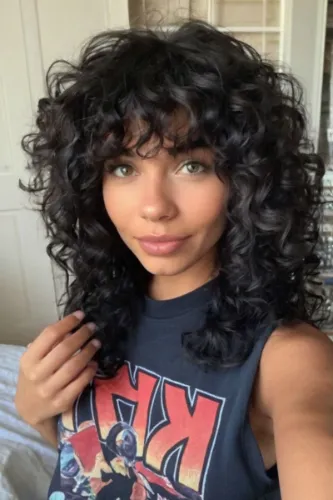
The challenge with wavy hair
The problem isn’t the wave – it’s the weight suppressing it. Dense mid-lengths pull it downward before the natural pattern has a chance to form. The result is hair that’s neither straight nor properly wavy: a frizzy, shapeless middle ground.
How the Wolf Cut addresses it
The key is where weight is removed, not how much. Too aggressive and the wave pattern breaks up. Too conservative and the problem stays. Done correctly, the Wolf Cut removes weight from the areas that suppress movement – typically the mid-lengths and below the occipital bone – while leaving enough surface density for the wave to hold its shape.
What that produces:
- Defined, sprung waves that sit naturally without product
- A curtain fringe that blends into the side layers without a visible break point
- A shape that looks considered but not laboured
Styling for wavy hair
Diffused in the morning and barely touched, this cut moves. By evening, a few drops of oil pulls the same shape into something sleeker – still effortless, just a different register of it. Wavy hair with a Wolf Cut genuinely transitions between occasions without a full restyle. Stylists call it the Beach-to-Boardroom look. The name is accurate.
The bottom line: the Wolf Cut gives wavy hair its structure back. The layers don’t fight the wave – they frame it.
The curtain fringe is where this framing becomes precise. Our face framing service shapes the bangs to blend seamlessly into the side layers – adapted specifically to how your wave pattern falls around your face.
For Curly and Coiled Hair
Curly hair has the opposite problem from fine straight hair – not too little volume, but too much of it in the wrong places. The classic triangle silhouette (narrow at the crown, wide at the sides) comes from curl patterns that expand outward rather than upward. The Wolf Cut restructures that distribution entirely.
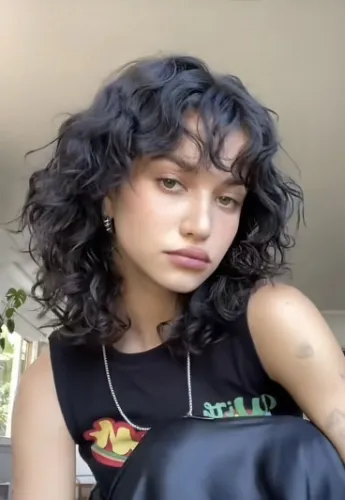
The challenge with curly hair
Bulk at the sides and a flat crown. This is the default shape for most uncut curly hair, and it’s frustrating because the curl pattern itself is beautiful – it’s just not going anywhere useful. Standard layered cuts often make it worse by removing too much length without addressing where the volume actually lives.
How the Wolf Cut addresses it
The most important thing: curls should be cut dry. Wet curls stretch. They behave differently, sit differently, and spring back to a completely different length once dry. A stylist cutting wet curls for a Wolf Cut is guessing at the result. Dry cutting removes the guesswork entirely.
The structural focus is the crown-to-nape ratio:
- Crown layers are cut to free the curls – allowing them to sit upward and outward, creating height rather than width
- Mid and lower layers are precision-tapered, reducing bulk at the sides without disrupting the natural curl pattern
- The nape length is preserved longer to maintain the Wolf Cut’s signature silhouette
Styling for curly hair
After a well-executed Wolf Cut, curls require less interference. A curl-defining cream applied section by section, then diffused or air-dried – the layers hold the shape. The result is curls that bounce, not puff. Controlled, not compressed.
The bottom line: the Wolf Cut gives curly hair its architecture. Volume becomes an asset, not something to manage around.
Dry cutting for curls is a specific skill, and not every salon offers it. Our stylists who adapt the technique to your curl type and density from the first consultation – and if you’re considering colour alongside the cut, our balayage service works particularly well on curly hair, where the natural variation in the curl pattern makes the colour move and catch light differently.
The 5 Ways the Wolf Cuts Elevate Your Look
Its staying power isn’t accidental. It solves real problems – styling time, face shape concerns, hair health – in ways that most haircuts don’t. These are the five reasons it holds up beyond the trend cycle.
1. Face-Framing Architecture
The curtain fringe is the most customisable element of the cut, and it carries significant weight. Bangs that fall at cheekbone level draw the eye horizontally across the widest point of the face, creating balance. Worn longer, grazing the nose bridge, they soften proportions and add depth. This isn’t decoration – it’s geometry. The fringe placement is where the stylist adapts the cut to your specific bone structure.
2. Effortless Maintenance
Day two hair. That’s the actual goal of this cut. The Wolf Cut is specifically constructed to improve as the week progresses – the layers settle, the texture develops, and what looked sharp on day one looks genuinely lived-in by day three. No restyling required. The cut does the work. The one thing that does need attention between appointments is the fringe – it grows fastest. A quick fringe trim keeps it exactly where it belongs.
3. Versatility of Occasion
The same cut handles a Tuesday morning without effort and pulls together for an evening out. Tousled at the roots with a salt spray – casual. Slicked back with a gel for a clean wet-finish – fashion-forward. Blown out at the crown and loosely pinned – polished. The Wolf Cut doesn’t lock you into a single aesthetic. It expands with your wardrobe.
4. Hair Health
Removing old, dense growth from the mid-lengths and ends isn’t only aesthetic. Uncut length causes tension at the root – particularly for fine and long hair – which leads to breakage over time. Layers reduce that load. With less weight pulling at the shaft, the hair grows cleaner. Shine improves because light reflects evenly off well-cut ends rather than scattering off damaged ones. Pairing the cut with a bond-repair service like Olaplex or K18 takes it further – you can explore the full range of hair treatments we offer to maintain condition between appointments.
5. Individual Identity
No two results look the same. They can’t. The layer placement, fringe depth, taper at the nape – all of it is built around the specific person in the chair. A skilled stylist isn’t reproducing a reference photo. They’re reading your growth patterns, your density, the way your hair falls when it’s dry – then building a shape that works with those specifics. The result is always yours.

Getting a Wolf Cut at Salon: What to Expect
The cut starts before the shears come out. A stylist will assess your hair density and porosity, growth direction, face structure, and how you actually wear your hair day-to-day. None of that comes from a reference photo – it comes from the conversation and from looking at what’s in front of them. That’s what determines where the layers go, how the fringe sits, and which tools get used.
On the tools: a feather razor suits wavy and curly textures, producing soft, diffused ends that move naturally. Precision shears with point-cutting give straight hair cleaner definition. A well-executed result often uses both within the same appointment.
When you sit down, come with a clear brief
- Define your drama level. A Soft Wolf keeps the layers long and blended – volume at the crown, but nothing that reads as disconnected. A Sculpted Wolf goes higher-contrast: heavy face-framing, shorter crown layers, maximum texture.
- Be specific about the fringe. Tell your stylist exactly where you want the curtain bangs to land – cheekbone level for balance, nose-bridge length for a softer, more blended finish.
- For thick or curly hair, ask for internal weight removal: the movement and the shaggy feel, without bulk sitting at the sides.
- Bring references, but explain them. Show the photo, then say what you like about it – the volume at the root, the wispy ends, the way the fringe falls. The more precise you are, the more precisely the stylist can build toward it.
Before anything is cut, ask for a texture analysis. Ten minutes that map your growth patterns and density – and shape every decision that follows.
Ready to find out what a Wolf Cut looks like on your hair specifically? Book a consultation and let’s work it out from there.