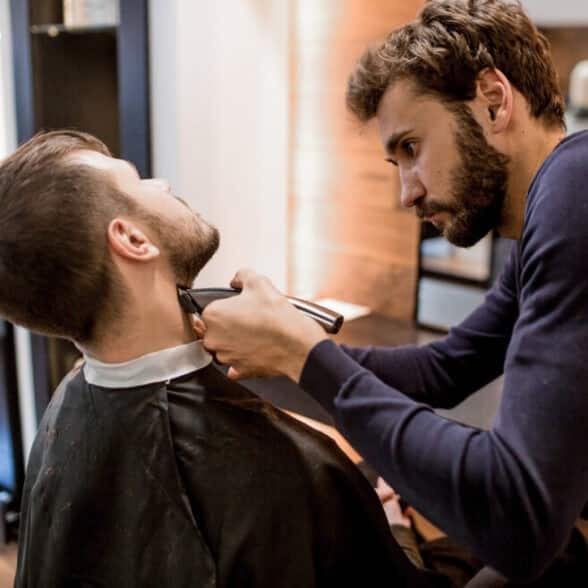
A professional beard trim is a barbering service that reduces length, corrects shape, and sharpens the lines around a beard using clippers, scissors, and a straight razor. It is not a shave and it is not a haircut with a slightly different tool. The goal is control: taking a beard that has grown unevenly and giving it a defined outline that matches the face underneath.
What Happens During the Session
A beard trim at PIED-DE-POULE follows a fixed sequence, so the result is consistent regardless of which barber picks up the clippers:
- Consultation on beard and face shape — the barber checks how the beard grows and how it sits against your jawline before cutting anything, not just the length you want off
- Neck and ear cleanup included — trimming stray hair along the neckline and ears is part of the same session, not a separate add-on
- Razor line-up as its own step — the straight razor comes in after clippers and scissors, specifically to define the neckline and cheek line
- Hot towel finish — the session closes with a hot towel rather than just an oil or balm, which settles the skin after the razor work
Nothing here is optional add-on work — it’s the standard structure of a beard grooming session, start to finish.
How It’s Different From a Haircut
A haircut and a beard trim look similar from the barber’s chair, but the hair itself behaves differently in each case:
- Scalp hair grows in one general direction, so clippers alone usually finish the job
- Beard hair grows in multiple directions across the jaw, neck, and cheeks, which is why clippers, scissors, and a razor are all used in sequence
- Clippers handle bulk reduction first, set to the length that suits the beard’s density
- Scissors take over for texture and blending where the clipper alone would leave it flat
- The razor comes in last, defining the two edges — neckline and cheek line — that decide whether a beard looks intentional or left alone
This finer, closer work is what separates a beard stylist’s approach from the guarded passes used in a standard haircut.
Choosing the Level of Service
Not every visit needs the full sequence. PIED-DE-POULE offers two levels of beard grooming, depending on how much the beard has grown out:
- Quick trim — clipper reduction and a scissor tidy, fast, no razor work, good for a light reshape between full appointments
- Complete service — adds the razor line-up and hot towel finish on top
The complete version is what most clients book when the beard has properly grown out or there’s an event to look sharp for.
Who Notices the Difference
A beard trim matters most in a handful of recognisable situations:
- The beard has grown past the collar and lost its outline
- Growth is patchy along the cheeks or neck and needs a defined edge
- There’s an event, interview, or photo where the beard needs to look finished
- The beard has been left untouched for a month or more and needs a full reshape rather than a light tidy
In each case, the fix is the same — bring the shape back under control before it gets away completely.
Results and How Long They Last
The result is visible the moment the barber finishes, not something that settles in over the following days:
- Clean lines and even length are visible immediately
- No stray hairs catching the light along the neck or cheeks
- The shape holds for two to four weeks before the outline starts to soften
A follow-up trim inside that window keeps every visit a touch-up rather than a full reshape.
Session Lengths and Pairing With Other Services
Timing depends mainly on whether the beard trim is booked alone or alongside another service:
- Standalone beard trim — 20 to 30 minutes
- Paired with a Men’s Haircut — around an hour combined, both done by the same barber in one visit
- Alongside a Men’s Manicure — a second specialist works on the hands while the beard trim is underway, so the total visit doesn’t run longer than the beard trim alone
Clients who keep a set beard length tend to book on a repeating two-to-four-week cycle, which is what keeps the maintenance light instead of starting from scratch each time.